

Curated by Margot de Gier, an emerging curator based in Melbourne, this collection explores how the body is symbolic and temporary, deeply intertwined with memory, culture and the natural world.
 Meg Williams 'Shop Window II'
The human body is a complex and fascinating state of being. Made up of billions of chemical reactions per second, the body is in a constant state of transition, where energy is used and created in complex systems that allow us to move through the world. In art, the realms in which the body holds meaning beyond our natural form are expansive and mesmerising. Ephemeral, strange and transient, many artists revisit the truly surreal nature of bodily human experience.
 Anne Marie Hall 'Resting'
In Zhang Huan’s ‘To Add One Meter to an Unknown Mountain’, performers awaken a bodily reckoning of Daoist philosophy, embodying an act of humility and futility by adding precisely one meter to an immense mountain range. The embodied act is simultaneously a movement out of a state-controlled gallery system under state oppression and economic reform. Through the body, artists reveal how philosophies, spiritual reckonings and political movements are held, created and transformed.
 Zhang Huan 'To Add One Meter to an Unknown Mountain'
In Buddhism, the body is viewed as a transient vessel, impermanent and the place of habitation for the mind and spirit. Similarly, Christianity views the body as a vessel of the mind, a place of sacred and moral significance. Adam Cullen’s ‘Christ’ embodies the transience of life, death and resurrection through an iconoclastic reinterpretation. A skeletal, decaying corpse replaces the traditionally valorised body of Christ - questioning how we understand the creation of life, certainty of death, and resurrection.
 Adam Cullen 'Christ'
Bodily experience is deeply intertwined with the Earth’s natural cycles of renewal. Growth, decay and infinite cycles of regeneration spur our body’s fluid and permeable transitions throughout different stages of life. Oscillating between fascination for the unknown and reverence for the familiar, many artists find inspiration in this intimate entanglement with the natural world.
 Anne Marie Hall 'Untitled (Fluid Portrait)' |
 Charles Blackman 'Hand and Leaf'
Channeling different eras of Australian art, Evie Cahir and George Baldessin encounter the body through private glimpses. Using cropped borders and rectangular thresholds to shift between exposure and concealment, transparency and secrecy, the artists explore the body’s transient relationships to domesticity, privacy and place.
 Evie Cahir 'Tess jumping from one part of the couch to the other, with her blue pants reflecting nicely on the white cushions' |
|

The body is often used as a symbol in art to construct or make sense of the world we live in. A place for cultural narrative and expression, many Australian artists use the body to explore transient experiences of Australian culture - through the body as an icon for cultural narrative and layered expression.
 Phillipe Le Miere 'Study for Balancing Children' |
|

How we move through space is a complex transformation between absence and presence. In a world never fixed nor static, remnants of the beautiful, tragic, thrilling, and mundane stories of people across history are left in their absence - even when they’ve just left the room.
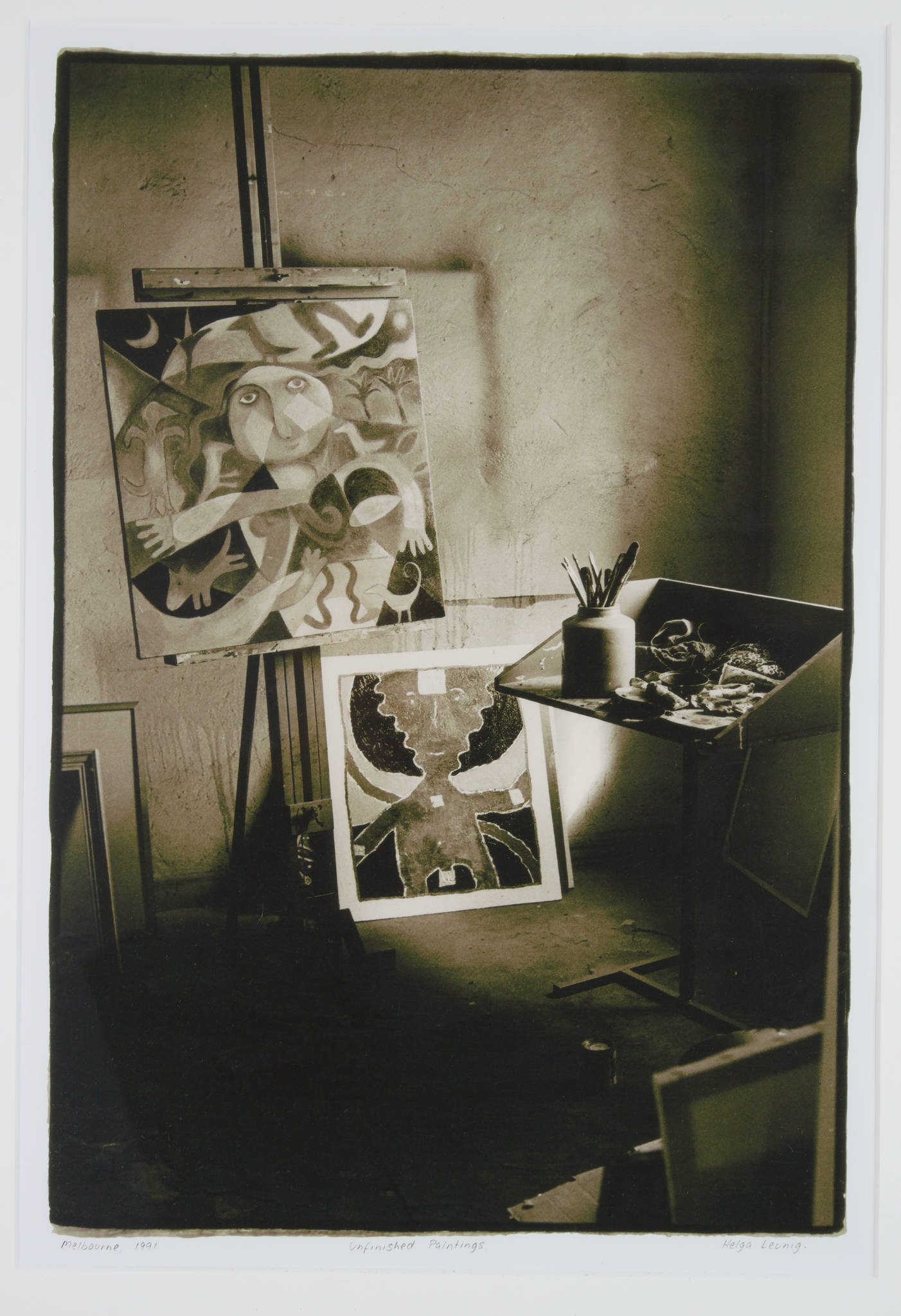 Helga Salwe 'Unfinished Paintings'