

How artists reimagine the human body
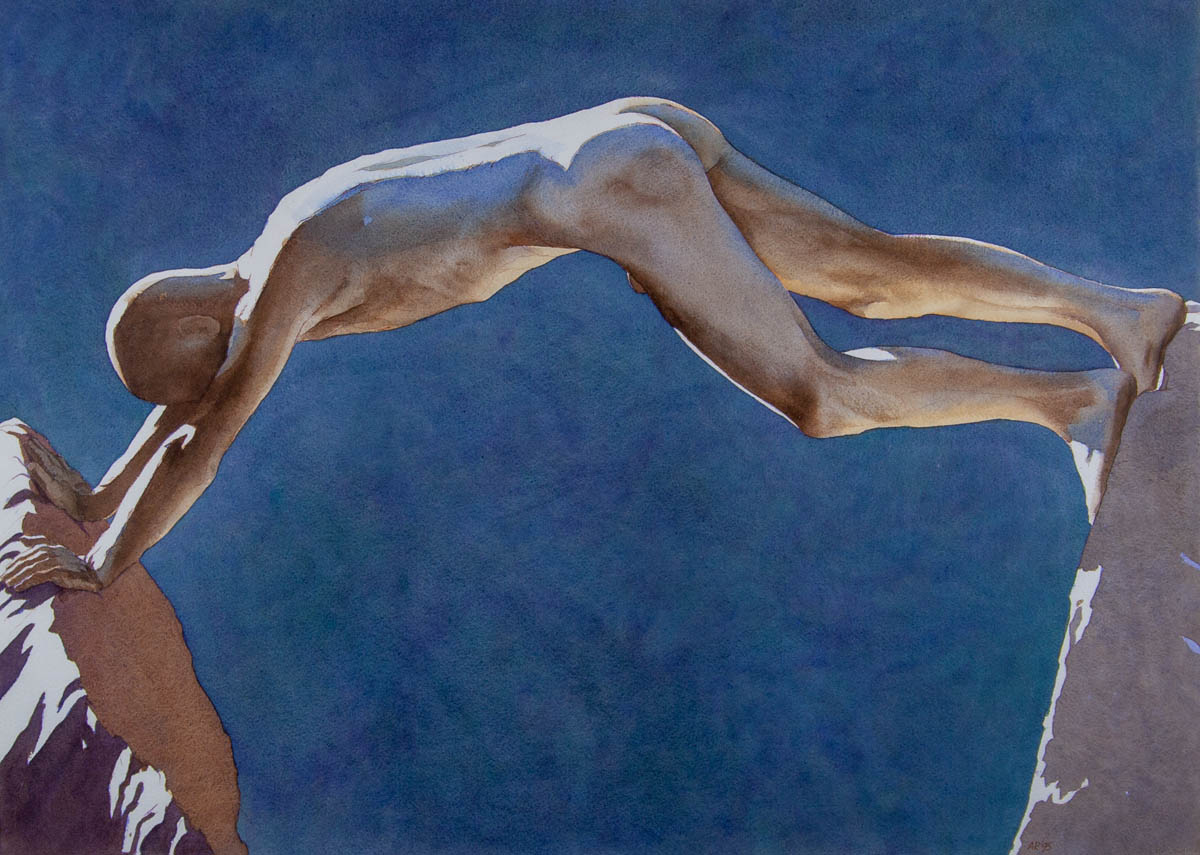 Arthur Russell 'Untitled (Between Two Points)'
The body is one of the most recognisable visual motifs in art; defying expected boundaries of culture, genre, and time, it seems every artist has taken inspiration from the natural state of the human body. Whether a depiction of a muse, or a representation of the self, the body in art often becomes a vessel for a larger perspective. More than simply human, the body becomes art itself.

George Baldessin 'The world of tinsel'
Whether it is the intention of the artist or not, every self-portrait is revealing. In the act of creating their own image, artists often are inadvertently conveying their inner workings - how they see themselves physically, and how their psyches manifest visually. In John Olsen’s ‘Self Portrait in a Kangaroo Landscape’, the artist uses his signature abstracted style to meditate on the idea that all forms of life are interconnected.

John Olsen 'Self Portrait in a Kangaroo Landscape'
In modern art theory, the nude is often a subject of contention. In many ways the ‘nude’ can be seen as distinct from the simple naked body - the nude conveys power, status, and authority. Where a naked body is intrinsically tied to its own humanity, a ‘nude’ is eternal. Drawing on canonised images of Venus and David, the ‘nude’ is something more than human.

For some artists, the body becomes a central focus of their practice. George Baldessin’s distorted depictions of female bodies are shrouded in psychological intrigue. For Baldessin, the fragmented and vulnerable body is used to explore ideas of human weakness and the fragility of human presence.

Charles Blackman 'Nude sitting'
Whether psyche-revealing self-portraits, or depictions of the world around them - how and why artists depict the human body continues to be a point of fascination. As described by philosopher Ludwig Wittgenstein, “the human body is the best picture of the human soul”.
